
Exhibits & Education

Preserving a Rich Cultural Heritage! The Allegany Museum collects artifacts, print and manuscript materials, maps, photographs, motion picture film, video and audio oral histories, paintings, and other items which have been created or used in the greater Cumberland, Maryland. Click the titles below to learn more about each exhibit!

Crossroads of America

1st Floor Exhibit

Cumberland’s foundation and history are tied to its geographic importance as a key east-west route linking coastal eastern America with the Ohio and Mississippi watersheds. The evolution of transportation via roads, canals, and trains in America and the role this played in encouraging westward colonization is a primary theme of the Allegany Museum.

The Crossroads of America exhibition traces the history of human movement through Cumberland and Allegany County. It is located in the beautifully renovated old Post Office space on the first floor of Allegany Museum, Pershing Street Cumberland MD.

The museum’s newest exhibition space highlights the evolution of transportation from about 1750 to 1900. Space will includes scale models of canal boats and trains, a fully restored 1825 Conestoga wagon, an to scale Paleoindian hut, a model of Fort Cumberland, models of what George Washington looked like when he visited our area in the 1750s, and in 1794, and displays about the National Road, the C&O canal, and the railroads.

As you move through the exhibition, visitors “travel” the Trail, the Road, the C&O towpath, and the rails.

Interpretive text, graphics, and models explain:

  • trade routes such as the Nemacolin Trail, an ancient Native American trail that connected the Potomac River and the Ohio and Monongahela River watersheds and linked native cultures before European contact.
  • events of the French and Indian War, particularly the need to transport thousands of men as well as wagons and artillery to the Ohio territory, spurring British investment in improving the Nemacolin Trail and the creation of the first road to cross successive ridgelines of the Appalachian Mountains.
  • the importance of the Cumberland Road or National Road, authorized in 1806 by President Thomas Jefferson, as the first highway built by the Federal Government to spur westward colonization.
  • the role of the B&O railroad and the C&O Canal, which reached Cumberland in 1842 1850, respectively, in transporting regional resources, especially timber and coal, and fueling America’s industrialization.

2nd Floor Exhibit

Maryland’s coal production reached its peak in the first decade of the 20th century and declined after World War I as new energy sources such as petroleum became important. The decline of coal mining and glassmaking hit Cumberland’s economy hard. As these and other small local industries such as breweries declined, the Kelly-Springfield Tire Company based in Ohio opened a tire manufacturing plant in Cumberland in 1921.

Kelly-Springfield began in 1894 as a manufacturer of rubber ties for carriages, patenting a process of placing a solid rubber tire in a rim channel. Kelly-Springfield tires were quickly adapted to the expanding automobile industry and the company thrived. The Kelly-Springfield company closed the Cumberland plant in 1987.

The Allegany Museum houses the complete archive from the Springfield-Kelly company’s offices in Cumberland, including the company’s business documents; artifacts created by the company as part of commemorative and marketing campaigns; and most makes and models of tires created during the company’s operation.

The opening of the National Road in 1811, the arrival of the B&O railroad in 1842, and the completion of the C&O Canal in 1850 turned Cumberland into a modern transportation hub. By the close of the Civil War, coal production in Appalachia had rocketed. Maryland was producing millions of short tons of coal a year that was fed to industrial and urban centers over Cumberland’s train and canal links. The Allegany Museum collects objects and information that document our region’s role in America’s post Civil War industrial boom. Our two key stories about the rise and decline of products Made in America are glassware and tire production.

Glassmaking and Breweries

Cumberland was an ideal location for glassmaking because of its proximity to rich coal deposits needed for fuel and silica sandstone, the raw material of glass. After about 1880, the city became a center of glass manufacturing. Local glass factories produced many popular patterns and obtained patents for some inventions.

Glass factories were dangerous places to work and commonly burnt to the ground. One of the earliest and most prominent glass companies, Wellington Glass Company, was completely destroyed by fire in 1920. Wellington Glass employed around 300 people, but the huge losses from the fire, estimated at $400,000, were insurmountable and the factory was not rebuilt. After 1930, glassmaking played a much-diminished role in the local economy. The Allegany museum is acquiring key examples of local glass as well as tools and archival information that document the history of this important industry.

The Glassware Collection is an important piece of Allegany Museum’s 50,000 plus items.

A substantial glassware industry flourished in Allegany County between 1880 and 1930. It peaked in the early 1920s, when it employed over 1000 workers and was one of the largest industries in the county. The Great Depression of the 1930s brought it to an end, with the exception of one small company that survived until 1961.

When the glass industry was at its peak there were major factories at four different sites in Allegany County. Companies came and went, factories burned and were rebuilt, but plants continued to operate at the same sites. The display features examples of the glassware produced by the different companies and provides an overview of the industry in the county.

Oster Toy Collection

The Oster Toy collection includes 90 transportation-related toys dating to the early 20th century. All the toys were made in the United States of metal and many are mechanical “wind-up” toys that are still in fine working condition. Items in the collection include a motorcyclist, a plane World War I-era boats, a Conestoga wagon, a 1920 Ford car, a carriage, a train, and many others.

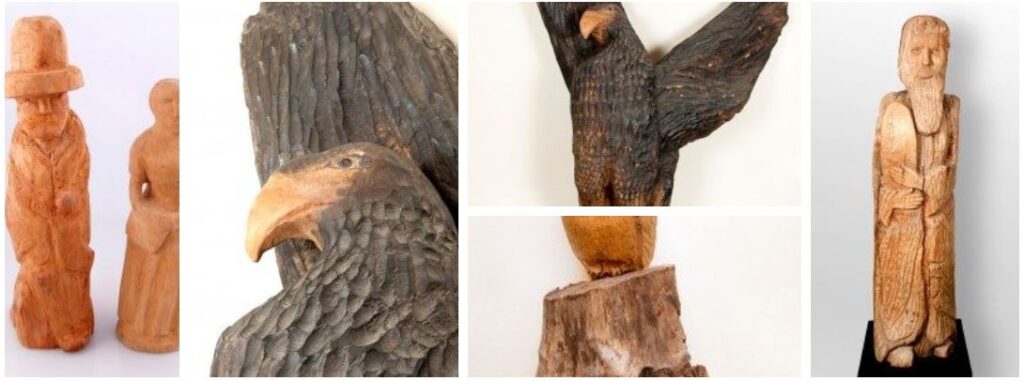
Claude Yoder Sculptures

Claude Yoder (1907 – 1991) grew up in the Amish-Mennonite community on a farm near Grantsville in Garrett County Maryland. His work shows what art critics call a technically naive but earthy sense of form and texture. The unique, fresh style received national recognition. Yoder’s family donated most of his life’s work to the museum.

Details coming soon!

Details coming soon!

Cumberland and the Allegany region played a key role in the early career of George Washington. The Allegany Museum’s new first-floor installation will highlight Washington’s role in our region. The exhibition space will include a large-scale model of Fort Cumberland and other Washington memorabilia from the 1750s, encapsulating his career as a surveyor and his participation in the French and Indian War or Seven Years’ War. The footprint of Fort Cumberland, including the fort’s old tunnels, sits steps from the museum. The cabin that served as Washington’s headquarters, the only building to survive from the fort, sits in a nearby park.

Before Washington was a military leader and the first President of the United States, he was a surveyor, a profession he began at the age of sixteen. Surveying trips took him along the upper Potomac River and to the western edge of the British Empire in America, at that time defined by the Allegany and Blue Ridge Mountains. In the 1750s French military and colonists began moving down the western side of the Allegany and Blue Ridge Mountains, following the Ohio and Monongahela Rivers. France’s push to colonize the Ohio Territory upset British interests. In 1753, the 21-year-old Washington volunteered to carry a letter from the governor of Virginia to the French commander of newly constructed forts along the rivers asking the French to withdraw from the region. Washington’s diplomatic party left Williamsburg, Virginia, in October 1753 and traveled to Fort Le Boeuf near Lake Erie and back, making the round trip of more than 1,000 miles by horse, foot, canoe, and raft in about ten weeks.

Washington’s group passed through Cumberland, then a rough outpost called Wills Creek, on the 14th of November. To travel from Wills Creek over the Allegany Mountains, Washington’s party would have followed the Nemacolin Trail, an ancient Native American trail that connected the Potomac River and the Ohio and Monongahela River watersheds. This route had become established as a primitive road used by settlers and traders. When Washington returned from his trip he wrote a report, which was published in 1754 as The Journal of Major George Washington. It became widely read and included a map of the region he traveled, showing the placement of French forts and heightening British concern about French incursion. Even before Washington’s return, the governor of Virginia sent troops to build a fort called Fort Prince George at the junction of the Allegheny and Monongahela rivers in what is now downtown Pittsburgh.

Washington returned to Wills Creek in the spring of 1754 as a newly commissioned lieutenant colonel. Washington was on his way back to Fort Prince George with troops and supplies. Before he could leave Wills Creek, he learned that Fort Prince George had been attacked and captured by the French, who built a new fort called Fort Duquesne. Between May and July 1754, Washington’s regimen camped near the modern town of Farmington, PA where his troops built Fort Necessity and also began to widen the road west to transport almost 400 men and small cannon towards an attack on Fort Duquesne. On July 4, a much larger French and Indian force attacked Fort Necessity. Washington abandoned the fort and retreated to Wills Creek. That fall, Wills Creek became the site of a crude wilderness fort called Fort Cumberland.

In 1755, Washington was at Fort Cumberland as an aide-de-camp to General Braddock, who had been sent westward with some 2,400 men, supplies, and cannons to force the French from the Ohio territory. Braddock spent months widening and improving the road linking Fort Cumberland and Fort Necessity, intending to take the road through to Fort Duquesne where he would assemble and attack the French. However, the British column was surprised not far from Fort Duquesne and roundly defeated. They retreated to Fort Necessity where General Braddock died of his wounds.

With the formal declaration of war between the British and French in 1756, the war became known as the French and Indian War or Seven Years’ War. In 1758, Washington participated in a campaign under Brigadier-General John Forbes that finally drove the French from Fort Duquesne. Then, he retired from military life until the onset of the Revolutionary War.

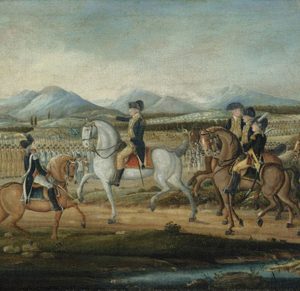
Washington returned to Cumberland a final time in October 1794, this time as President and Commander-in-Chief of the newly formed United States of America. He came to review troops at Fort Cumberland, intending to march into Pennsylvania to suppress an uprising called the “Whiskey Rebellion.” Upon Washington’s arrival in Cumberland, the rebellion dissipated. It has been suggested that this act was a crucial early test of the power of the newly formed central government.

Additional Collection Highlights Include:

  • Fossilized mammals from 500-700 thousand years ago
  • Archaeological evidence of Native American settlement in the area
  • A model of Fort Cumberland, an important part of the early career of George Washington
  • Markers from the National Road dating to before 1835
  • Historic Research and Button Collection from Al Feldstein
  • Civil War journals and battle gear from local families
  • Post-Civil War artifacts from regional industries such as breweries and glassmaking
  • Artifacts, equipment, and vehicles showing the rise of modern firefighting techniques
  • A collection of early 1900s metal toys documenting transportation history

Educating and Inspiring Our Community

The mission of the Allegany Museum includes creating digitally accessible collections, developing quality resources for educators based on the museum’s collections and special exhibitions, and fostering research projects to further knowledge of and interest in our region. We invite you to contact us to learn how you can support these worthwhile projects as a sponsor or volunteer.

Making our collections accessible to all.
In tandem with the creation of a new exhibition space on the first floor of our historical building, the collections staff is currently undertaking a program to catalog and digitize the entire museum collection, including archival documents. This process will result in the creation of a web-accessible search interface allowing access from anywhere in the world to information about holdings.

Providing educational materials for grades K-12.
The museum’s investment in special exhibitions includes creating didactic materials keyed to the curriculum for the state of Maryland. We are working to digitize these materials and provide them free of charge. Some materials can be provided upon request.

Partnering in investigating the archaeology and history of Mexico Farms. 
The Mexico Farms Archaeology Project is centered on the life history of an early 19th-century farmhouse located between the Potomac River and the C & O Canal, and on examining Native American occupation of the land before the establishment of the farm. The project provides opportunities for community members to engage with the archaeology and the history of the Allegany region in a tangible way.

If you are an educator planning a trip to the museum, please contact the museum at info@alleganymuseum.org or 301-777-7200 to schedule a tour for your group and obtain pre- and post-visit educational materials to enhance your student’s educational experience.